


Yes. In the UK, fake reviews have been illegal since 6 April 2025, when the Digital Markets, Competition and Consumers Act 2024 (the DMCC Act) added them to the list of practices banned outright in consumer law. The ban covers writing fake reviews, paying or rewarding someone else to write them, hiding the fact that a review was incentivised, and showing reviews in a misleading way. The Competition and Markets Authority (CMA) enforces the rules and can now fine businesses directly.

What the law bans
The rules sit in Schedule 20 of the Act, which lists commercial practices that are always treated as unfair. For reviews, it bans:
- Submitting a fake review, or commissioning someone else to submit or write one. A fake review is one that claims to be based on a person's genuine experience but isn't.
- Submitting or commissioning a review that hides the fact it was incentivised.
- Publishing reviews, or information drawn from them such as star ratings and review counts, in a misleading way.
- Publishing reviews without taking reasonable and proportionate steps to prevent and remove fake reviews and hidden incentivised ones.
- Offering services to businesses to do any of the above, which covers firms that sell reviews.
The CMA's guidance says the ban applies to fake negative reviews as well as fake positive ones, in any form, whether written, spoken or as images, and whether they appear online or offline.
What it means for a small business
Most small businesses never set out to break these rules, but a few common habits now carry legal risk. The CMA's guidance and examples point to these:
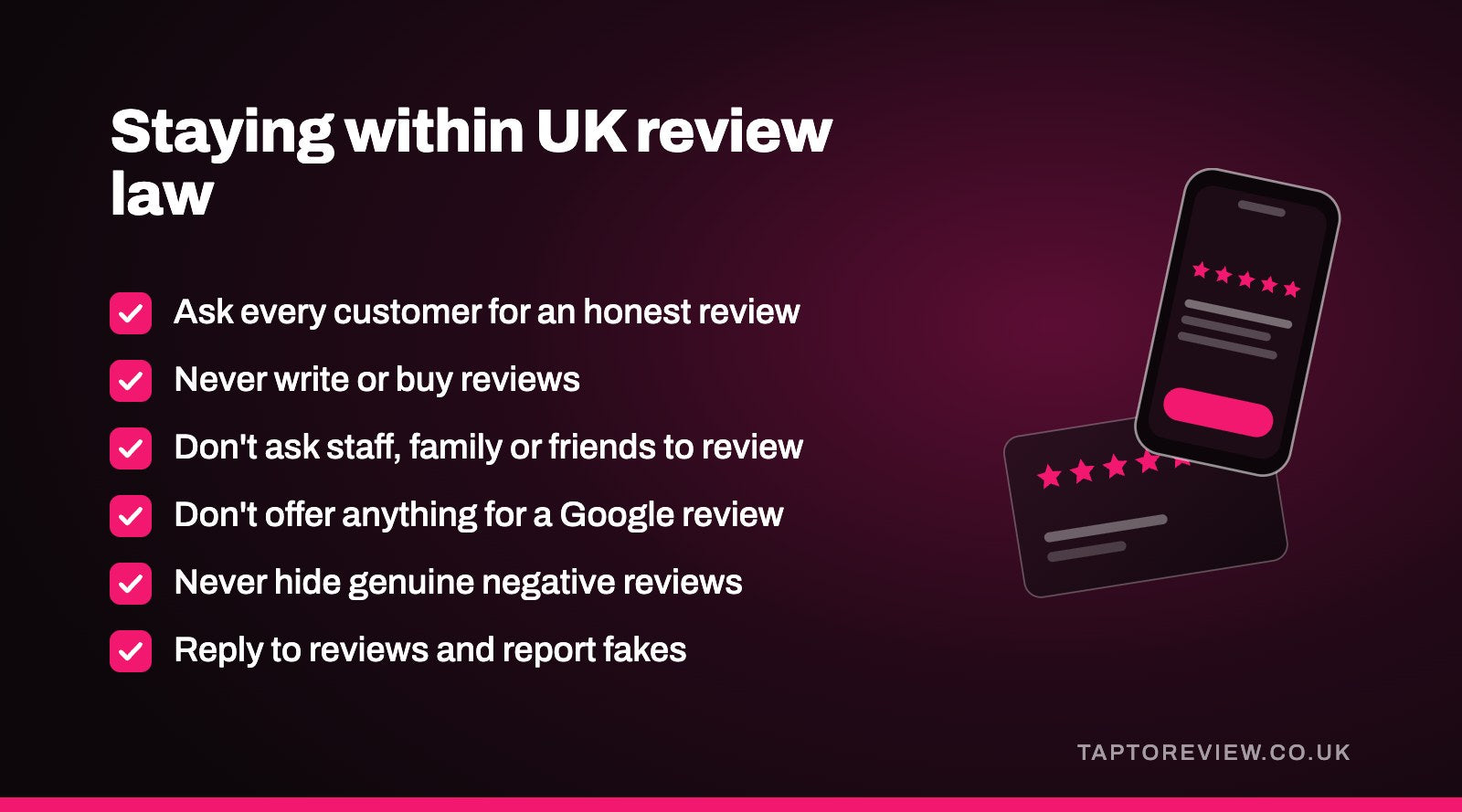
- Writing reviews of your own business, or asking staff, family or friends to. The guidance says asking a member of staff to write a review counts as commissioning it.
- Buying reviews, or paying an agency or app to post them.
- Leaving fake negative reviews about a competitor.
- Offering discounts, freebies or money for reviews without that being made clear in the review. On Google, incentives aren't allowed at all.
- Offering a refund or gift card to a customer if they change a negative review so it no longer reflects what happened.
- Cherry-picking, either by only inviting happy customers to review or by hiding or removing genuine negative reviews.
If you show reviews on your own website, the publishing rules apply to you as well. The guidance says selecting only favourable reviews to present, when they don't reflect what reviewers say overall, can be misleading. A widget set to show only four and five-star reviews could be seen that way, so think about how you present them. Our guide to showing Google reviews on your website covers the options.
What you can still do
The CMA is clear that encouraging genuine reviews is fine. Its guidance says that asking customers generally whether they'd like to leave a review, without trying to dictate what they say, isn't prohibited. It also says a review isn't fake just because the business doesn't like it or disagrees with it, as long as it reflects the reviewer's genuine experience.
So you can ask every customer for an honest review, share your review link, use cards and stands that open your review page, reply to reviews and report ones you believe are fake. Our article on Google's rules on asking for reviews covers what Google allows on top of the law.
Penalties and enforcement
Under its direct enforcement powers, the CMA can investigate and decide for itself that a business has broken consumer law, without first going to court. The Act caps the fine for an infringement at £300,000 or 10% of the business's worldwide turnover, whichever is higher, and the CMA can also order a business to change what it's doing. Trading Standards and other enforcers can take businesses to court under the same rules, and the courts can impose penalties up to the same limit.
The CMA said it would spend the first three months after April 2025 mainly helping businesses comply. In March 2026 it opened investigations into five businesses over reviews. They include whether the funeral company Dignity asked staff to write positive reviews, and whether the fresh pasta company Pasta Evangelists gave customers discounts on future orders for five-star reviews on delivery apps without saying so. At the time of writing the CMA hadn't reached findings in any of them.
Google also made commitments to the CMA in January 2025. UK businesses found to be raising their star ratings with fake reviews can have a warning shown on their Google profile and their ability to receive new reviews turned off, and repeat offenders can have all their reviews deleted for six months or more.
Common questions
Are fake reviews illegal in the UK?
Yes. Since 6 April 2025, writing, buying or commissioning fake reviews is a banned practice under the DMCC Act. Our article on whether you can buy Google reviews covers buying in more detail.
Can my staff or family review my business?
Google doesn't allow it, as they have a conflict of interest. Under the law, asking staff to write a review counts as commissioning it, and a review that hides a connection to the business may be misleading.
Is posting a fake review a criminal offence?
The review ban isn't one of the banned practices the Act makes a criminal offence in itself. It's enforced mainly through CMA fines and court orders, although other parts of consumer law on misleading customers do carry criminal offences.
What if a competitor leaves fake reviews about my business?
Fake negative reviews are covered by the ban too. Report them to Google first. Our guide on what to do when a competitor leaves fake reviews goes through the steps.