


Review gating means only asking the customers you expect to be happy for a Google review, or steering unhappy customers away from leaving one. The usual version is a message that asks how the visit went and only sends the satisfied customers on to Google. Google's policy doesn't allow it, and in the UK it can also break consumer law, which since April 2025 has banned publishing reviews in a misleading way.

What review gating looks like
Gating isn't always obvious, and some businesses do it without realising. These are the common forms:
- A follow-up text or email that asks for a star rating first. Customers who pick four or five stars get your Google review link, and customers who pick fewer are sent to a private feedback form instead.
- A sign or message saying something like "Loved your visit? Leave us a Google review. Not happy? Email us instead."
- Staff told to hand the review card only to customers who seem delighted, or to skip anyone who complained.
- Sending review requests only to regulars or to customers who've already paid you a compliment.
- Switching review requests off during a bad week and back on again once things have settled down.
In each case, whether a customer gets asked depends on whether you expect a good review from them. That's the part Google and the CMA object to, even when every review you end up with is genuine.
What Google's policy says
Google's rules for content on Maps cover this under rating manipulation. They say businesses must not "discourage or prohibit negative reviews, or selectively solicit positive reviews from customers". The same section says businesses shouldn't require or pressure customers to leave a review while they're on the premises, and shouldn't ask for specific content in a review.
What Google does allow is encouraging genuine reviews from customers, without offering anything in return and without trying to influence the rating or what people write. Google removes reviews it treats as rating manipulation, and its guidelines say it can suspend Business Profiles that break its rules.
What UK law says
The Digital Markets, Competition and Consumers Act 2024 added a ban on fake reviews and misleading reviews to UK consumer law from 6 April 2025. One part of it bans publishing consumer reviews, or information drawn from them such as star ratings, in a misleading way.
The Competition and Markets Authority (CMA), which enforces the rules, has published guidance on what this covers. It describes cherry-picking positive reviews as something that can be done by suppressing negative reviews or by encouraging only satisfied customers to leave reviews, and it says this may break the law. The same guidance warns businesses against stopping and starting review invitations arbitrarily, and against making an offer to resolve a complaint depend on the customer not leaving a negative review.
The CMA can now fine businesses directly for breaking these rules. Our guide to UK fake review law covers the Act and the penalties in more detail.
Is it gating to deal with complaints privately?
No. Sorting out a complaint directly with the customer is good practice, and many unhappy customers would rather talk to you than write a review. The problem comes when the private route replaces the review instead of sitting alongside it.
It's generally fine to give every customer a way to contact you as well as your review link, as long as unhappy customers still get the link and aren't put off from using it. What isn't fine is offering a refund, a discount or anything else on condition that the customer doesn't leave a review, or removes one they've already left. Google treats that as an incentive, and the CMA guidance lists it as a problem under the law too.
What to do instead
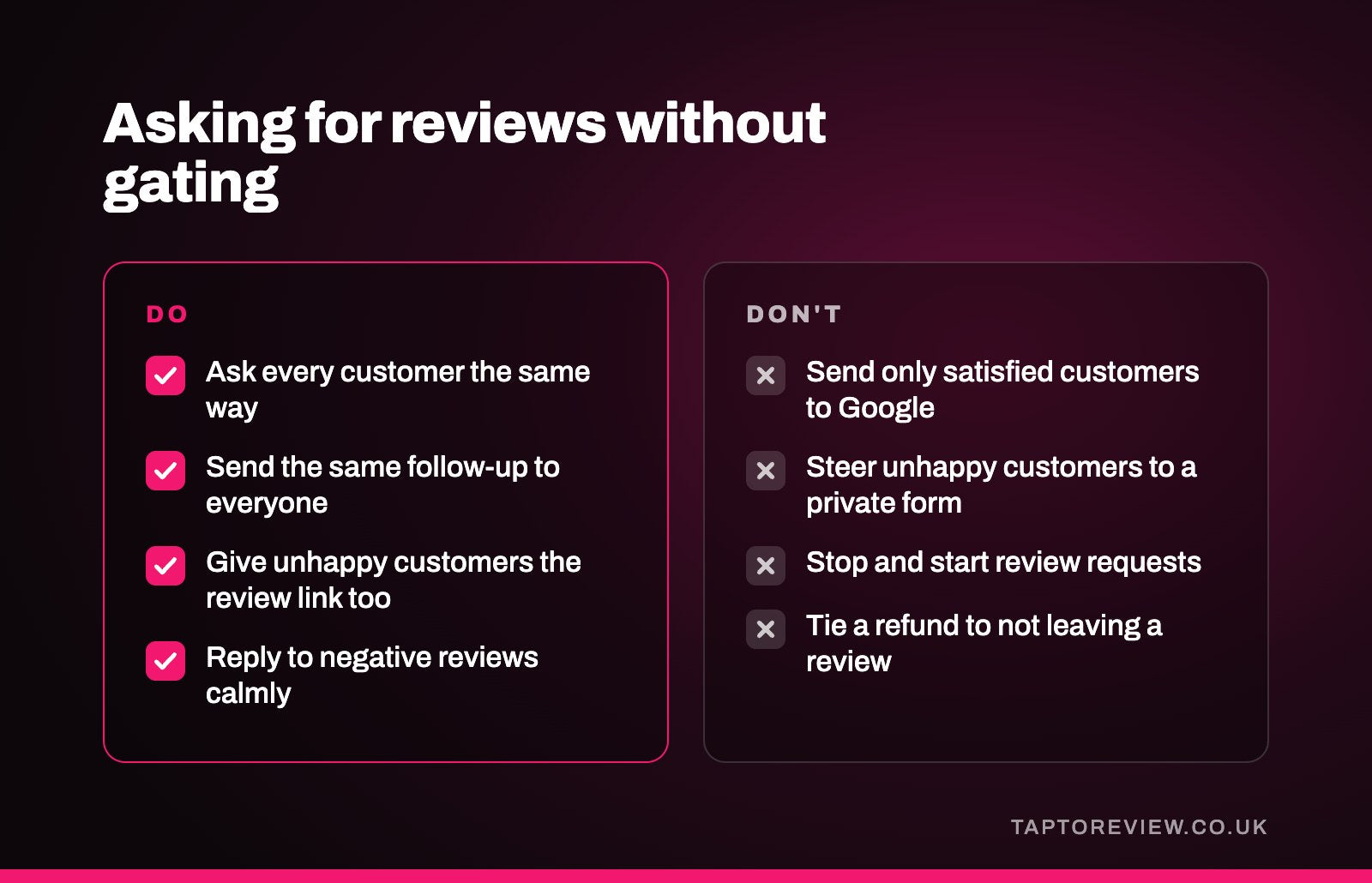
- Ask every customer the same way, using one short line that all your staff can use.
- Send the same follow-up to everyone, whatever you think of how their visit went.
- If you use review software or a booking system, check for any setting that filters customers by their score before showing them your Google link, and turn it off.
- Give unhappy customers the review link too, and offer to put things right separately.
- Reply to negative reviews calmly. Other customers read your replies when they're deciding whether to use you.
Our guide on how to ask customers for Google reviews has wordings that work for everyone. A Google review stand on the counter suits this approach, as it's there for every customer who pays and nobody has to decide who gets offered it.
Common questions
Is review gating illegal in the UK?
It can be. The CMA's guidance says encouraging only satisfied customers to leave reviews is a form of cherry-picking that may break the ban on publishing reviews in a misleading way. It's also against Google's policy regardless of the law.
Can I ask for feedback before asking for a review?
Yes, as long as every customer is then given the same chance to leave a Google review, whatever their answer was. If only the positive answers lead to your review link, that's gating.
Is it gating to only ask my regulars?
If you pick them because you expect them to be positive, yes. Ask everyone you serve instead.
What should I do if my review software has a gating feature?
Turn it off, so that every customer sees your Google review link. Our article on Google's review rules covers the other things to avoid.