


The businesses that get the most Google reviews do three things consistently. They ask every customer at the moment the customer is happiest, they make leaving a review take seconds rather than minutes, and they reply to the reviews they get. None of it needs special software. Below are the methods that work for most UK small businesses, roughly in order of how much difference they make.

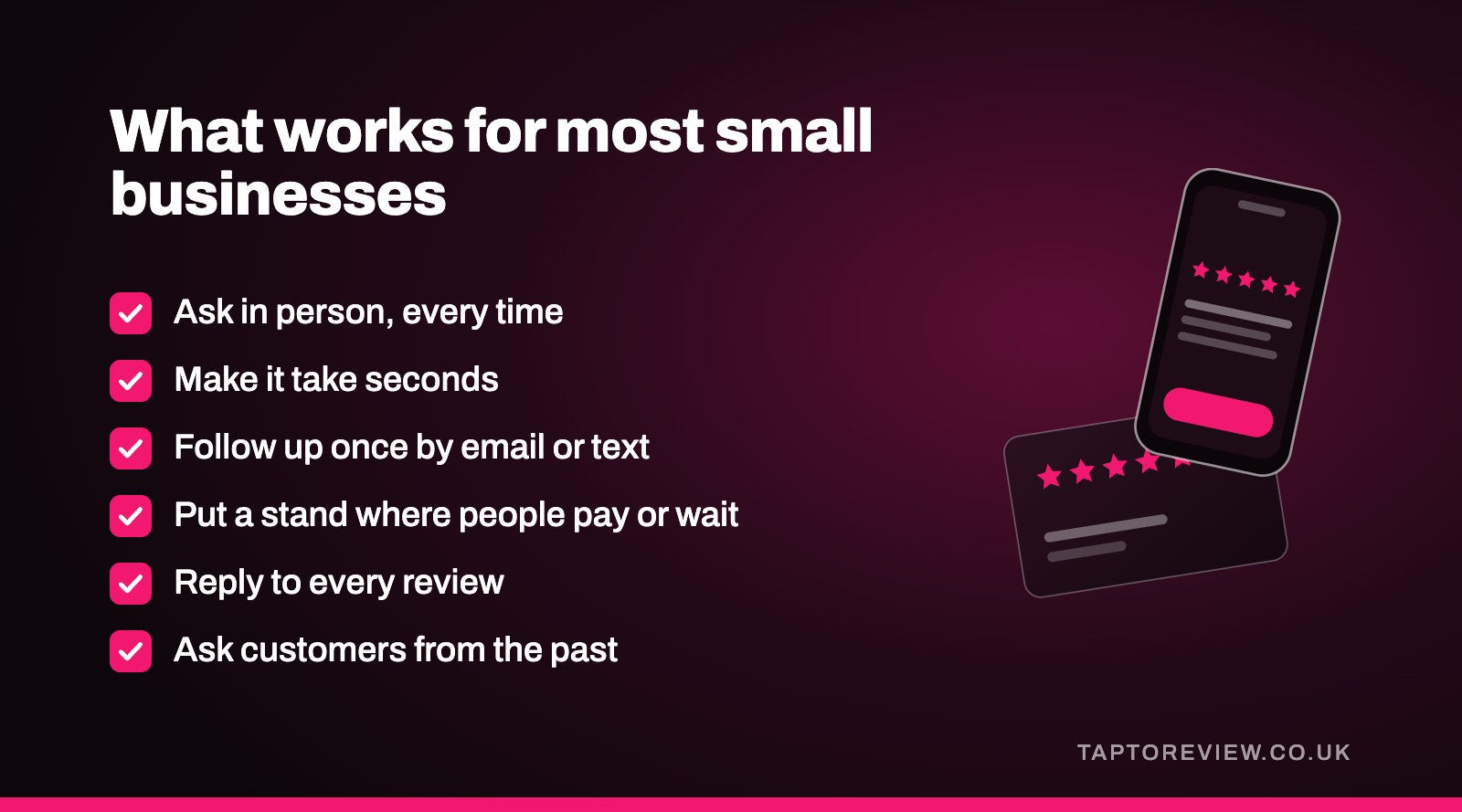
1. Ask in person, every time
A spoken request from the person who served the customer is the single biggest factor. Most customers who are happy with a business are willing to leave a review, but few think to do it unprompted. A short, friendly sentence at the end of the visit is enough. Our guide on how to ask customers for Google reviews has wordings you can borrow.
2. Make it take seconds
Every extra step loses people. If a customer has to search for your business, pick the right listing from the map, scroll to the reviews and find the button, many give up halfway. Give them a direct route instead:
- Your Google review link in emails, texts and invoices.
- A Google review QR code on menus, receipts and posters.
- An NFC card, stand or sticker that opens the review page when a customer taps their phone on it.
3. Follow up once by email or text
Some customers mean to leave a review and forget. One short message the same day or the next, with your review link in it, catches a lot of them. Send it from a person's name and keep it to two or three sentences.
4. Put a stand where people pay or wait
A Google review stand next to the card machine or on a reception desk reminds customers without anyone having to say anything, and it gives staff something to point to when they do ask.
5. Reply to every review
When people can see that a business answers its reviews, they're more inclined to leave one. A reply also shows future customers how you deal with problems, which matters most with the occasional negative review.
6. Make reviews part of the routine
- Agree one wording for asking and use it across the team.
- Give every customer-facing member of staff their own review card.
- Share new reviews with the team each week, especially ones that mention someone by name.
- Check your review count once a month so you can see whether it's moving.
7. Ask customers from the past
If you keep customer emails, you can send one message to people who've used you in recent months asking for a review. Keep it honest and simple, and send it to everyone on the list, not just the customers you remember as happy.
What not to do
Don't offer discounts, free items or prize draws for reviews, don't only ask customers you expect to be positive, and never buy reviews or ask staff and family to post them. Google removes reviews that break these rules, and fake reviews are illegal in the UK. We've covered this in more detail in Google's rules on asking for reviews.
How quickly will reviews come in?
It depends on how many customers you see and how consistently you ask. A busy café that asks at the till will get reviews faster than a builder who finishes a few jobs a month. What matters most is that the asking becomes a habit, so reviews keep arriving steadily. A steady flow of recent reviews looks better to customers than a burst followed by months of nothing.
Common questions
What's the fastest way to get Google reviews?
Asking customers in person at the end of their visit, with a way to leave the review straight away, such as a tap card or QR code.
Can I get Google reviews without asking?
Some customers will review you unprompted, but usually only a small number. Most businesses with a lot of reviews ask for them.
Should I reply to every review?
Yes, if you can. Short, genuine replies are fine. A simple thank you that mentions what the customer bought or had done reads better than a copied reply.