


Most staff review competitions aren't allowed under Google's policy. Google says businesses shouldn't ask staff to bring in a certain number of reviews, or reviews that mention a staff member, so a leaderboard for the most reviews, or the most reviews naming each person, runs straight into that rule. Recognising staff for good service and for asking every customer is a greyer area, and whether it's fine depends on how you run it.

What Google's policy says
Google's rules for content on Maps cover this under rating manipulation. When businesses ask for reviews, the policy says they shouldn't require or pressure customers to leave a review while on the premises, and shouldn't request that specific content is included. It gives two examples of what that means for staff: asking staff to bring in a certain number of reviews, and asking staff to get reviews that include specific content, including content that identifies a staff member.
Two other rules matter here. Businesses can't offer customers anything in return for a review, and people with a conflict of interest, which includes current and former staff, shouldn't review the business. Google removes reviews it treats as rating manipulation.
Competitions that cross the line
Based on that policy, these are the set-ups to avoid, even if the prize is only a box of chocolates:
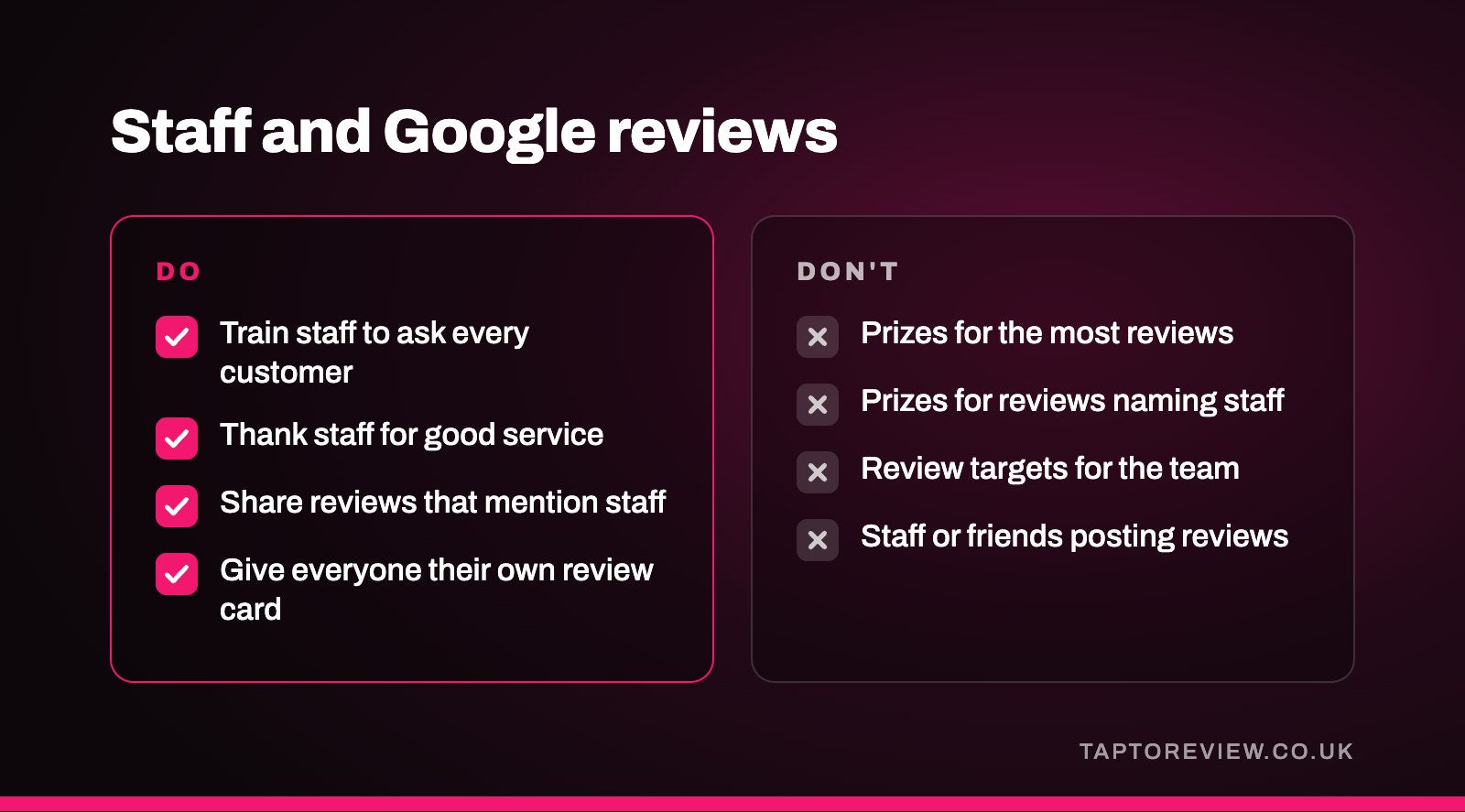
- Prizes for the most reviews in a week or month.
- Prizes for reviews naming staff, such as a bonus for every review that mentions you.
- Prizes for the most five-star reviews, which adds pressure on the rating as well as the number.
- Review targets for the team, with a reward when the business reaches a set number of reviews.
- Anything where staff or friends posting reviews could help someone win.
Why these competitions cause problems
Apart from the policy itself, review contests tend to change how staff behave with customers. Someone who's one review behind on the leaderboard will be tempted to ask more than once, to wait while the customer writes it, or to only ask the customers who seem happiest. Pressuring customers on the premises is against Google's policy, and only asking happy customers is review gating, which our article on review gating explains.
There's a legal side too. Under the Digital Markets, Competition and Consumers Act 2024, which has applied since April 2025, fake reviews are banned. The Competition and Markets Authority's guidance says a business asking a member of staff to write a review counts as commissioning it, and that a review from an employee which doesn't make the connection clear may be misleading. A competition that leads staff to post reviews themselves, or to get friends to, puts the business in that territory, and Google removes reviews from staff as a conflict of interest in any case.
The grey area: rewarding staff for asking
Google's policy doesn't say anything about rewarding staff for asking customers in general, so we can't point to a rule that says it's fine, and nothing in the policy forbids it either. In our view, these are on safer ground:
- Train staff to ask every customer, and include it in how you judge someone's work, based on what a manager actually sees.
- Thank staff for good service, whether you notice it yourself or a customer mentions it.
- Share reviews that mention staff in team meetings, without any money or prize attached.
A reasonable test is to ask what the prize depends on. If it depends on reviews appearing, on how many there are or on what they say, leave it out. If it depends on staff doing their job well, including asking everyone, it's much harder to see a problem. Our article on Google review incentives covers rewards for customers and staff more generally.
Getting your team to ask without a contest
What gets reviews in most businesses is staff asking every customer at the right moment, in the same way. Agree one short line that everyone uses, and agree when to ask, whether that's at the till, at the end of an appointment or when a job is finished. Give everyone their own Google review card so the review page is one tap away when they ask, and nobody has to go looking for one. Our guide to review cards for teams and multiple locations covers setting this up across a team.
Common questions
Can I run a competition for staff to get Google reviews?
Not one based on the number of reviews or reviews that name staff. Google's policy says businesses shouldn't ask staff to bring in a certain number of reviews or reviews that identify a staff member.
Can staff ask customers to mention them in a review?
No. Asking for specific content, including a staff member's name, is against Google's policy. Customers often mention staff anyway, and that's fine.
Can I reward staff who are mentioned in reviews?
This is a grey area. Thanking someone is fine, but a regular reward for being named soon encourages staff to ask for it, which Google doesn't allow.
Is a review target for the whole team allowed?
Google gives asking staff to bring in a certain number of reviews as an example of what not to do, so a team target is best avoided.